


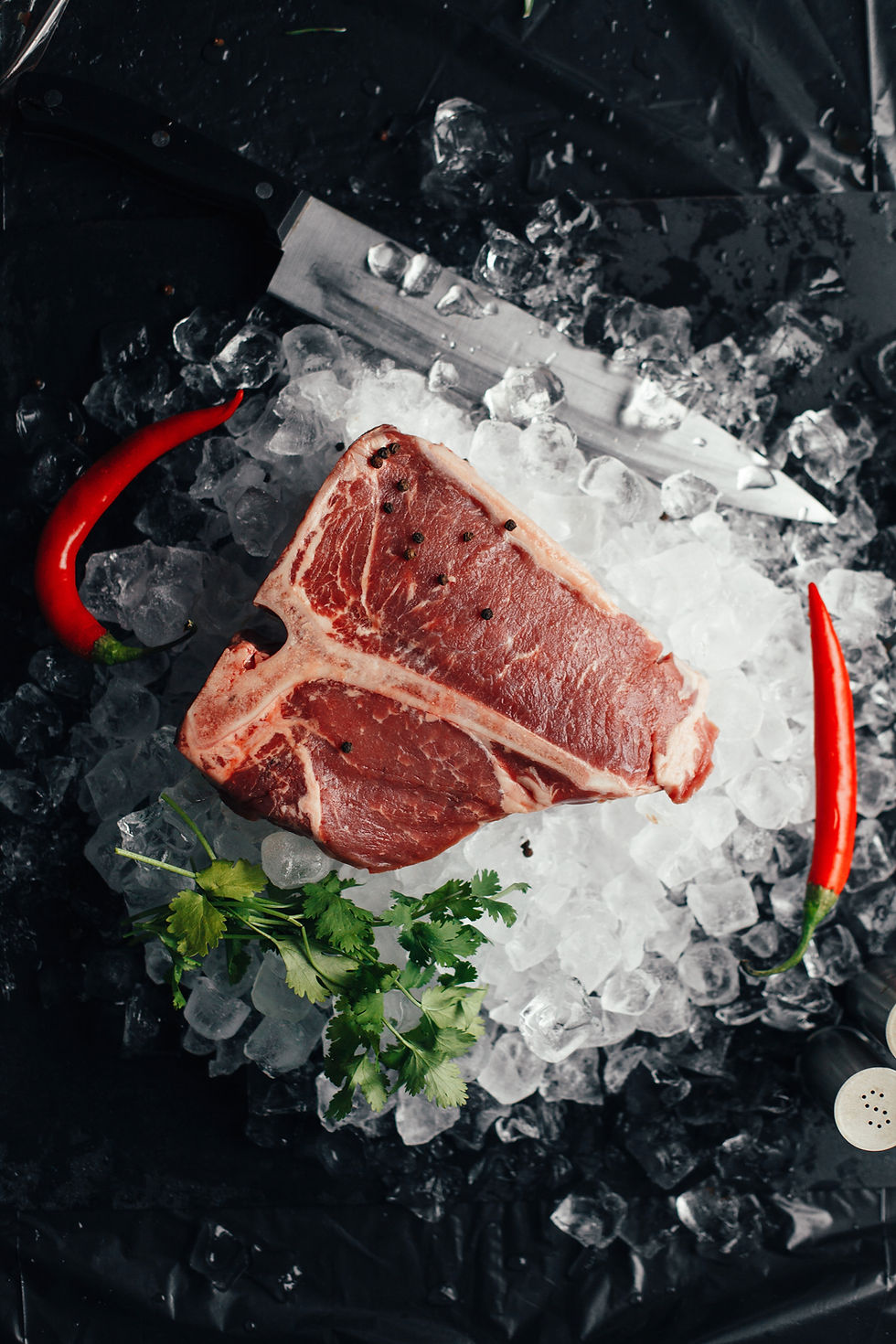


Our Steaks
At Farm Country, we believe that great steaks start with quality ingredients and careful attention to detail. That’s why we take pride in our selection of meats, which are always fresh and of the highest quality. Our expertly trained butchers hand-cut each piece of meat to ensure that it is tender and flavorful. We understand that the quality of our steaks is a reflection of the hard work we put in, and we are committed to making sure that every customer leaves our shop satisfied.


The Chuck
Beef chuck comes from the forequarter. Consisting of parts of the neck, shoulder blade and upper arm - these tougher parts are ideal for slow cooking. Some cuts from the chuck, such as Flat Iron Steak, are very tender and perfect for the grill.
The chuck has a good deal of connective tissue, which is why stew meat generally comes from this area. Due to its fat content, beef chuck is also an excellent source of ground beef, that appears in most of our grounds and burgers.
The Rib
The rib section of the animal doesn't get much activity, therefore it yields some of the most tender meat on the animal. The upper center section of rib - specifically the sixth through the twelfth ribs - is used for the traditional standing rib roast or "prime rib" dinner.
The ribeye is situated high on the back of the cow. Its beautiful marbling makes it ideal for dry aging and produces some of our most popular cuts - including our ribeye steaks, rib chops and rib roasts. These cuts are best for grilling, roasting, searing, or frying.
Short Loin
The short loin is where we find some of the most desirable cuts of meat. These include T-bones, Porterhouse Steaks, Strips, and the Tenderloin. The tenderloin, which can be cut into filet mignon steaks, actually starts in the short loin and continues into the sirloin. A whole tenderloin is removed from both sections, trimmed to about 3.5lbs and sold as a roast. The strip steak is found one of two ways, the boneless New York Strip or the bone-in Kansas City Strip - both considered among the higher-end cuts of beef.
Steaks from the short loin are cut starting at the rib end and working toward the back of the animal. The first-cut steaks are strip steaks, next are T-bones, and two or three porterhouse steaks are available at the sirloin end.
Cook steaks from the short loin at high heat from the start, in a broiler or hot grill, to get a good sear on the exterior. Then finish the steak slowly over lower heat, until a meat thermometer placed in the center is a perfect rare to medium-rare (120-125°F).
The Sirloin
Beef Sirloin is the hip, located below the short loin and the round and divided into top sirloin and bottom sirloin.
We fabricate the top sirloin into steaks that are good for grilling, such as our American Wagyu Top Sirloin. The bottom of the sirloin is usually divided into three main components - the tri-tip, ball tip, and the sirloin flap.
The Tenderloin
The Tenderloin, found within the uppermost part of the sirloin, is the most tender cut of beef and where we get Filet Mignon Steaks from. Kept whole, the Tenderloin can be roasted to perfection.
Beef Tenderloin should only be cooked using dry-heat methods, such as grilling and broiling. The meat is already super tender, so keep cooking times short, and the heat high.
we offer a few varieties of Tenderloin and Filet Mignon Steaks - including Wagyu, Grass-Fed and Prime.
The Round
The beef round basically consists of the back leg of the steer. Muscles from the round are fairly lean, but they're also tough because the leg and rump get a lot of exercise. Whichever cut from the round you choose – top round, bottom round or knuckle, they do not have enough collagen (which turns to gelatin when braising or slow-roasting meat). The round is typically ground to balance out the fat in a high-fat beef grind for a burger.
The Brisket
Beef brisket is one of the most flavorful cuts of meat, although it is tough and needs to be cooked in just the right way. It's also fairly fatty, helping it cook into moist, meaty perfection.
Taken from the area around the breastbone, the brisket is basically the chest or pectoral muscle of the animal. The characteristically thick, coarse-grained meat needs a lot of time and low-temperature cooking to break down and tenderize.
Brisket is perfect when slow cooked in a barbecue, smoker, or in a flavorful braising liquid.
The Plate
Also called the short plate (or "long plate" depending on where it's separated from the rib muscle above it), the beef plate includes the short ribs and the skirt steak.
Skirt steak is the diaphragm muscle and is extremely flavorful. It's also a thin piece of meat, allowing you to cook it quickly over high heat. Because it has coarse muscle fibers, slice it against the grain or it will be chewy.
Beef plate contains a lot of cartilage, especially around the ribs, which is why beef short ribs are ideal for braising. This process of cooking with moist heat at a low temperature will dissolve cartilage and turn it into gelatin.

The Shoulder (Pork Butt)
Pork butt is actually the shoulder connected to the upper front leg. The rectangular roast at the top of the leg is known as the “butt,” or “Boston butt,” as some call it. The “picnic” or “picnic shoulder,” which comes from the lower part of the shoulder, has a more triangular shape.
It’s used for pulled pork or, when cured, for ham. Pork butt is a combination of both lean meat and fat, and is generally pretty large—it can be up to 8 pounds, or more. Pork shoulder is frequently braised for long periods of time, benefitting from the slow cooking and low heat to create rich and juicy meat.
The Back Fat (Fatback)
This fat is just under the skin of the back, and offered with or without the skin (the rind). Fatback is a hard fat that is a staple of Southern-style cooking, and is critical to making traditional charcuterie.
The Loin
The loin section, found between the shoulder and the leg on both sides of the backbone, contains some of the most popular cuts: tenderloin, sirloin, blade end, chop and the center loin.
This section features less fatty but very tender, cuts covered by a layer of fatback. Here, this is where we get both the Gloucester Old Spot pork chops and porterhouse chops.
The Spare Ribs
Spareribs come from the lower ribs of the pig where they meet the breastbone. With their high fat content, spareribs are a rich and succulent part of the pig, most often served barbecued so the fat drips away as it melts. There can be no better example than the Gloucester Old Spot spare ribs. The heritage breed has an excellent fat-to-meat ratio and deliciously rich-tasting meat.
The Bacon (Pork Belly)
Is there any part of any animal more popular than where we get bacon and pork belly? These fatty cuts of meat come from the side or belly area of the pig, and are particularly high in fat content.
Unlike bacon, which is cured, smoked, and generally served in a slab or slice, pancetta (thought of as the Italian form of bacon) is cured with salt and spices but not smoked. Pork belly is bacon that has not been cured, smoked, or sliced. Instead, it’s often braised or seared in small pieces. Any way you slice it, try the Gloucester Old Spot pork belly…it’s the most widely enjoyed meat we know!
The Ham (Leg)
While the pork leg makes a wonderful roast when butchered into small roasts or left whole (to braise or cook over dry heat), the leg is most often used to make ham—one of the most popular pork preparations. Here, Gloucester Old Spot legs are sold as both small individual roasts we butcher by hand, or one large fresh roast.
You may find these fresh roasts available bone-in or boneless, and either way, they make a festive centerpiece to any meal. The pork leg, or ham, is most often cured and served sliced. It can be very haute cuisine, as in the Italian prosciutto, or broadly available as the sliced ham we see at the deli.
The Shank (Hock Ham)
The ham hock comes from the bottom part of the pig’s hind leg: it’s rarely eaten whole. It combines bone, meat, fat, gristle, and connective tissue. It’s usually smoked and/or cured before being sold. Ham hock is most frequently used to flavor dishes, particularly soups and stews.